
Scalable attack propagation model and algorithms for honeypot systems
A Bar, B Shapira, L Rokach, M Unger Big Data (Big Data), 2016 IEEE International Conference on, 1130-1135 Link to document Attack propagation models within honeypot systems aim at providing insights about attack strategies that target multiple honeypots, rather than analyzing attacks on each honeypot separately. Traditional attack propagation models focus on building a single […]
Spot the Hotspot: Wi-Fi Hotspot Classification from Internet Traffic
Andrey Finkelshtein, Rami Puzis, Asaf Shabtai, Bronislav Sidik SBP-BRiMS (2016) Link to document The meteoric progress of Internet technologies and PDA (personal digital assistant) devices has made public Wi-Fi hotspots very popular. Nowadays, hotspots can be found almost anywhere: organizations, home networks, public transport systems, restaurants, etc. The Internet usage patterns (e.g. browsing) differ with […]
Researchers sabotage 3D printer files to destroy a drone
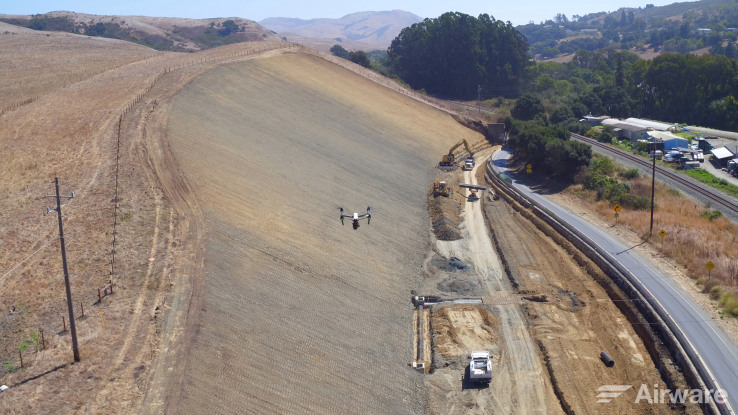
Researchers at Ben-Gurion University of the Negev (BGU), the University of South Alabama, and Singapore University of Technology and Design have successfully injected malicious code into a computer which, in turn, added invisible commands to a file containing a 3D model of a drone propeller. When they printed the model and attached it to the […]
MIMO Gaussian broadcast channels with common, private and confidential messages
Z. Goldfeld In Proceedings of the 2016 IEEE Information Theory Workshop (ITW-2016), Cambridge, UK, September 2016 Link to document The two-user multiple-input multiple-output(MIMO) Gaussian broadcast channel (BC) with common,private and confidential messages is considered. The transmittersends a common message to both users, a confidential messageto User 1 and a private (non-confidential) message to User2. The […]
Maryland Governor Visits BGU to Talk Cyber Security Collaborations

Maryland Governor Larry Hogan led a large delegation to BGU last week with the intent to generate “real collaboration” in the field of cyber security research as well as other fields. Hogan headed a week-long trade delegation comprised of some of his officials, representatives of four Maryland universities and members of the Jewish community. “This is […]
Network Flow Watermarking: A Survey
Cooperation with Singapore University of Technology and Design A Iacovazzi, Y Elovici IEEE Communications Surveys & Tutorials ( Volume: 19, Issue: 1, Firstquarter 2017 ) Page(s): 512 – 530 Link to document Traffic analysis (TA) is a useful tool aimed at understanding network traffic behavior. Basic network administration often takes advantage of TA for purposes […]
How America’s 911 emergency response system can be hacked

Critical to the success of the 911 emergency phone system, which has saved countless lives since it was first implemented in 1968, is its ability to quickly route calls to emergency responders closest to a caller. But a group of researchers say they’ve found a way to effectively disable the 911 emergency system across an […]
BGU Researchers Demonstrate How Data Can Be Stolen From Isolated “Air-Gapped” Computers Through a Typical USB Flash Drive
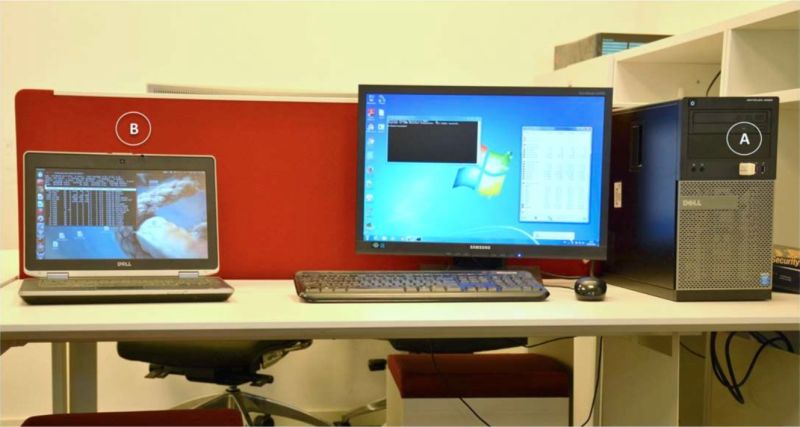
Above: Illustration of USBee, in which an ordinary, unmodified USB drive (A) transmits information to a nearby receiver (B) through electromagnetic waves emitted from the drive data bus. Researchers at BGU’s Cyber Security Research Center (CSRC) have demonstrated that an unmodified USB connected to a computer with malicious code can be used to steal data from infected and even air-gapped” […]
Broadcast channels with privacy leakage constraints
In collaboration with Technische Universit¨at M¨unchen Z. Goldfeld, G. Kramer and H. H. Permuter Accepted to the IEEE Transactions on Information Theory, August 2016 Link to document The broadcast channel (BC) with one common and two private messages with leakage constraints is studied, where leakage refers to the normalized mutual information between a message and […]
BGU Cyber Security Researchers Present DiskFiltration: Data Exfiltration from Speakerless Air-Gapped Computers via Covert Hard Drive Noise

Air-gapped computers are disconnected from the Internet physically and logically. This measure is taken in order to prevent the leakage of sensitive data from secured networks. In the past, it has been shown that malware can exfiltrate data from air-gapped computers by transmitting ultrasonic signals via the computer’s speakers. However, such acoustic communication relies on […]
DiskFiltration: Data Exfiltration from Speakerless Air-Gapped Computers via Covert Hard Drive Noise

DiskFiltration: Data Exfiltration from Speakerless Air-Gapped Computers via Covert Hard Drive Noise. By Security Researcher Mordechai Guri and Yosef Solewicz, Andrey Daidakulov and Yuval Elovici Link: https://arxiv.org/abs/1608.03431 Air-gapped computers are disconnected from the Internet physically and logically. This measure is taken in order to prevent the leakage of sensitive data from secured networks. In the past, it has […]
Semantic-security capacity for wiretap channels of type II
In collaboration with Princeton University Z. Goldfeld, P. Cuff and H. H. Permuter IEEE Transactions on Information Theory, vol. 62, no. 7, pp. 3863-3879, July 2016 Link to document The secrecy capacity of the type II wiretap channel (WTC II) with a noisy main channel is currently an open problem. Herein its secrecy-capacity is derived […]